


PBL Lami Tube Sizes and Capacity
PBL Lami Tube Sizes and Capacity: How to Choose Diameter, Length and Fill Volume
Published by Antilla Propack on 12 October 2026
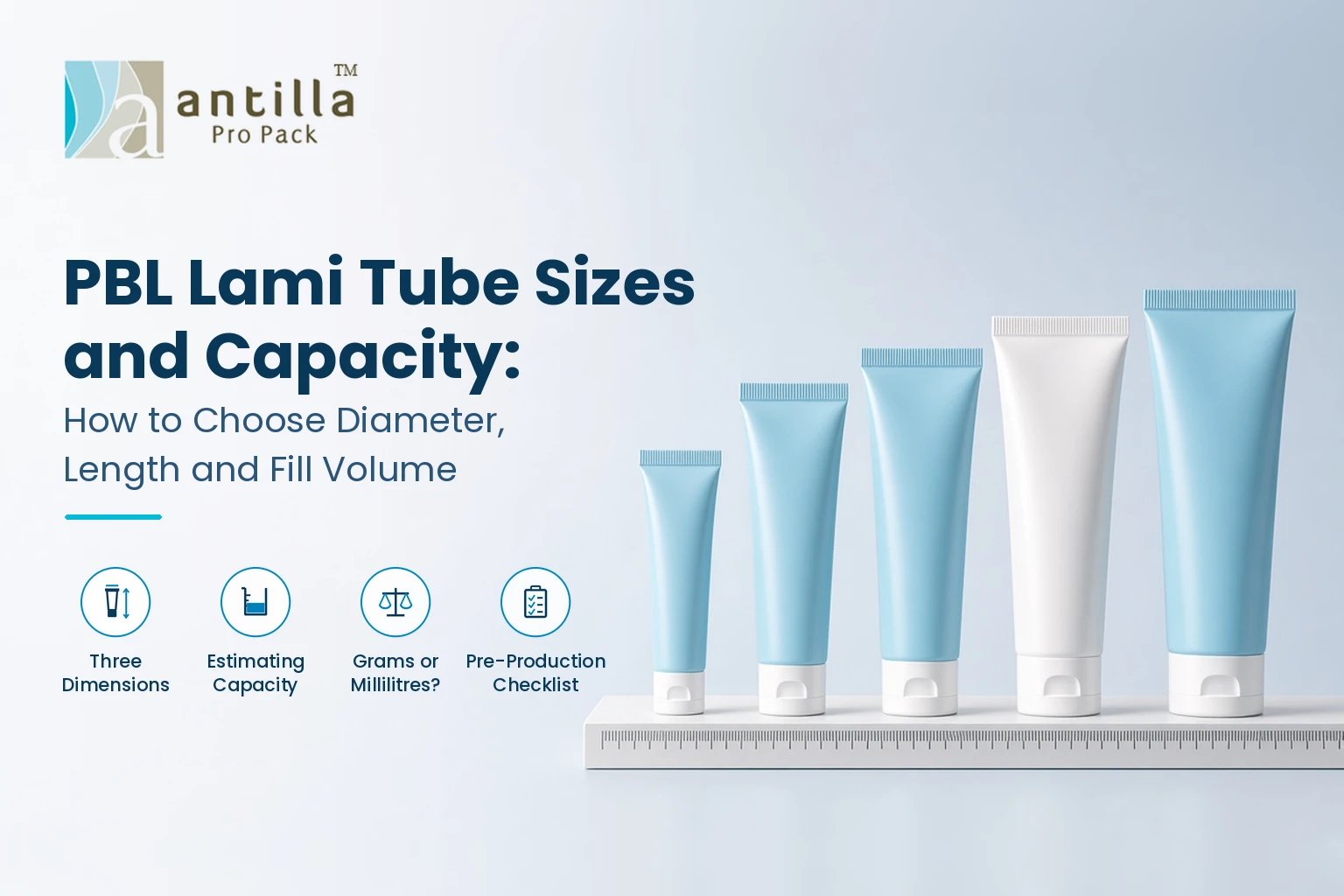
Once a brand decides on PBL lami tubes, the next question is always the same: which size? A tube that is too small leaves no room for sealing; one that is too large looks half-empty and wastes material. The right size depends on fill volume, product density, shelf presence, cap choice and how the tube will be filled.
This guide explains how PBL tube sizes work, gives a simple way to estimate capacity and lists the checks to run before you finalise. For the product itself, see our plastic barrier lami tube page.
The Three Dimensions That Define a Tube
- Diameter: the width of the tube body. It affects capacity, how the tube feels in the hand and how much print area you get.
- Length: measured from the shoulder to the open end before sealing. Part of this length is used by the seal at the bottom.
- Laminate thickness: affects stiffness and feel more than capacity.
Laminated tubes are commonly produced from about 16 mm to 35 mm in diameter, with length chosen to match the fill.
Estimating Capacity
A useful first estimate treats the tube as a cylinder:
Approximate capacity (ml) ≈ 0.785 × D² × Leff ÷ 1000
where D is the diameter in millimetres and Leff is the usable length in millimetres after allowing for the bottom seal and headspace. For example, a 25 mm tube with about 100 mm of usable length holds roughly 0.785 × 625 × 100 ÷ 1000 ≈ 49 ml.
Because the sealed end flattens, real capacity is usually lower than this estimate. Always confirm with physical fill trials using your actual product.
Indicative Size Ranges
| Diameter | Typical fill range (indicative) | Common uses |
|---|---|---|
| 16 mm | About 5–15 ml | Trial packs, eye creams, lip care |
| 19 mm | About 10–30 ml | Sample sizes, spot treatments, travel packs |
| 22 mm | About 15–50 ml | Serums, small creams, gels |
| 25 mm | About 30–75 ml | Face creams, sunscreens, small face washes |
| 28–30 mm | About 50–120 ml | Face washes, hand creams, hair gels |
| 35 mm | About 100–200 ml | Family-size face washes, body lotions |
These ranges overlap because length can be adjusted. Exact capacities depend on the tube length, seal size and your product.
Grams or Millilitres?
Many creams and gels are labelled by weight (g), while tubes are sized by volume (ml). Convert using your product's density: volume (ml) = weight (g) ÷ density (g/ml). A cream with density 1.05 g/ml needs about 95 ml of space for 100 g. Light, airy products need more room than dense pastes.
Choosing Between Two Valid Sizes
- Shelf presence: a wider tube gives more print area and a bolder shelf look.
- Hand feel: slimmer tubes feel premium for serums and treatments.
- Product range consistency: using one diameter across a range keeps the shelf uniform.
- Cap fit: some caps, such as stand-up caps, suit certain diameters better.
- Filling line: confirm your filling machine's holders support the chosen diameter.
Pre-Production Checklist
- Confirm the declared net quantity and product density.
- Shortlist two sizes and request samples.
- Run fill trials with your product and sealing method.
- Check headspace, seal quality and appearance after sealing.
- Finalise artwork on the chosen size, since print area changes with diameter.
- Run a compatibility and stability check with filled tubes.
PBL Sizes Across Product Categories
The same sizing approach applies across cosmetic lami tubes, skin cream tubes, hair colour tubes and mehndi tubes. Pharmaceutical brands should also read what pharma brands should check before ordering lami tubes.
Size Customisation at Antilla Propack
Established in 2009 in Rajkot, Gujarat, Antilla Propack manufactures laminated tubes for cosmetic, pharmaceutical, toothpaste and food brands, with diameter, length, print and cap customised to each product. Our R&D team can help you shortlist sizes and run fill trials.
Related Reading
- PBL lami tubes: structure, benefits and uses
- How PBL lami tubes are manufactured
- Cosmetic lami tube artwork and labelling guide
Frequently Asked Questions
What sizes do PBL lami tubes come in?
Laminated tubes are commonly produced in diameters from about 16 mm to 35 mm, with the length adjusted to give the required fill volume.
How do I calculate the capacity of a lami tube?
Estimate it as 0.785 × diameter² × usable length ÷ 1000, with dimensions in millimetres, to get millilitres. Real capacity is lower because of the sealed end, so confirm with fill trials.
Which tube size is right for a 100 g cream?
Convert weight to volume using the product's density, then choose a diameter and length that hold that volume with enough headspace for sealing. A 30 mm to 35 mm tube is often suitable, but fill trials should confirm it.
Does tube diameter affect the print area?
Yes. A wider tube has a larger surface for printing, so artwork should be finalised only after the tube size is fixed.
Can Antilla Propack customise tube length?
Yes. Antilla Propack customises diameter, length, print and cap to match each brand's product and fill volume.
Get Help Sizing Your PBL Tube
Contact Antilla Propack or call +91 951-081-2341 with your product, fill volume, artwork and quantity.